


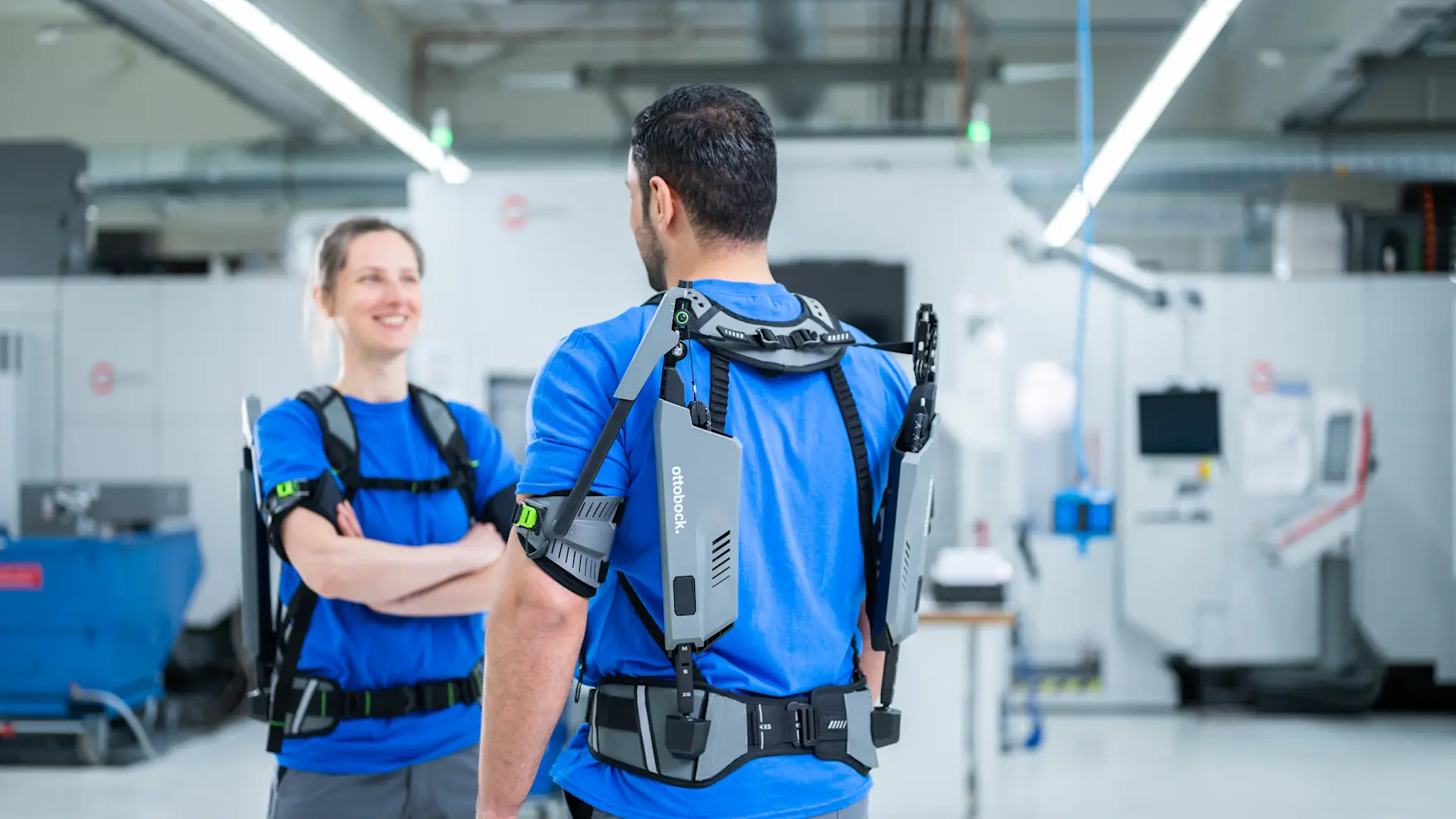
Warehouse work is one of the most physically demanding jobs in modern industry. Thousands of repetitive movements every day — bending, lifting, carrying, overhead work and continuous dynamic motion — push the human body to its limits. And that often happens without proper ergonomic protection or support.
Over time, this type of repeated strain leads to pain in the lower back, shoulders and knees — the most common reasons for absenteeism in logistics.
Exoskeletons address this problem directly. They do not force workers to move faster, but they allow them to maintain the same pace throughout the day without pain, fatigue tremors or loss of strength. For employees, that means a healthier workday, and for employers — more stable processes and fewer injuries.
Here are the five most impactful benefits exoskeletons provide for warehouse workers, backed by research and real industrial use.
1) Reduced load on the lower back
The biggest enemy of a warehouse worker is not one heavy lift, but the repetition of small but physically demanding tasks.
Bend down – lift the box – carry – put down.
Repeat that cycle 1500 times in a shift and you have a perfect recipe for lower-back overload.
An exoskeleton absorbs part of the lifting force and stabilises the torso at the moment when the spine is under the highest pressure. The worker still performs the movement, but with far less strain — often reduced by 40 to 60 percent. Muscles are no longer at maximum load, posture improves and the risk of injury decreases dramatically.
After hours of lifting, the difference becomes visible: workers bend less into unsafe angles, maintain control more easily and simply do not wear out their bodies like before.
2) Easier overhead work and less shoulder fatigue
Working with hands above shoulder height creates extreme strain. The arms are held in the air, repetitive motions accumulate fatigue, and every additional centimetre of height increases torque on the shoulder joint.
Warehouse workers often describe it as a “burning sensation” in the shoulders — especially in the final hours of a shift.
Shoulder-supporting exoskeletons help carry the weight of the arms and reduce muscle activation during overhead tasks. The result is tangible:
- less fatigue in shoulders and upper arms
- more stable and controlled overhead movements
- reduced risk of inflammation and joint damage
- longer continuous work without pain-induced pauses
In high-racking warehouse environments, the impact is significant — workers can remain productive longer without performance drop-off.
3) A more stable work tempo throughout the shift
Physical work doesn’t strain the body at one moment — it drains slowly, hour after hour.
In the early shift, workers are fast and precise. After several hours, the body fatigues, pace drops, mistakes increase and the risk of injury rises.
Exoskeletons slow down this decline.
By offloading critical muscle groups, they help employees maintain a consistent pace, concentration and posture throughout the entire shift.
Operationally, this means fewer micro-breaks, smoother takt time, fewer movement compensations and fewer errors.
In practice: the worker can maintain normal performance for the full shift — without feeling “burnt out” by early afternoon.
4) Lower injury risk and fewer sick-leave days
Most warehouse injuries are not dramatic accidents — they are micro-damages that accumulate silently, day after day.
Discomfort becomes stiffness.
Stiffness becomes pain.
Pain becomes long-term absence.
Exoskeletons change the force distribution on the body and reduce the strain that leads to chronic damage over time.
Companies that implement them repeatedly report:
- fewer musculoskeletal injuries
- lower sick-leave frequency
- faster recovery after demanding shifts
- increased long-term availability of labour
This is not only a health benefit — it has direct operational and financial impact.
5) Higher worker motivation and lower turnover
One effect of exoskeletons is often more important than the physical one — the psychological one.
A worker wearing an exoskeleton feels:
- protected rather than exploited
- less pain and better recovery at the end of the day
- more energy for family and personal life
- motivation to stay in a company that invests in their well-being
In industries with high labour demand and limited workforce supply, this can directly reduce turnover and improve retention.
Conclusion
Exoskeletons are not a gadget and not science fiction.
They are a practical, measurable tool that allows warehouse workers to perform demanding tasks with less strain, less pain and more strength throughout the entire day.
For employees, this means a healthier career with lower injury risk.
For companies, it means fewer sick days, more stability, and a motivated workforce that stays longer.
If you want to test exoskeletons in your warehouse or evaluate which models best fit your operation, we can support you with pilot testing, equipment selection and implementation inside real workflows. Feel free to reach out to us.